
SS304L & SS316L Stainless Steel Pipes, Fittings & Butterfly Valves for Dairy and Food Processing Plants
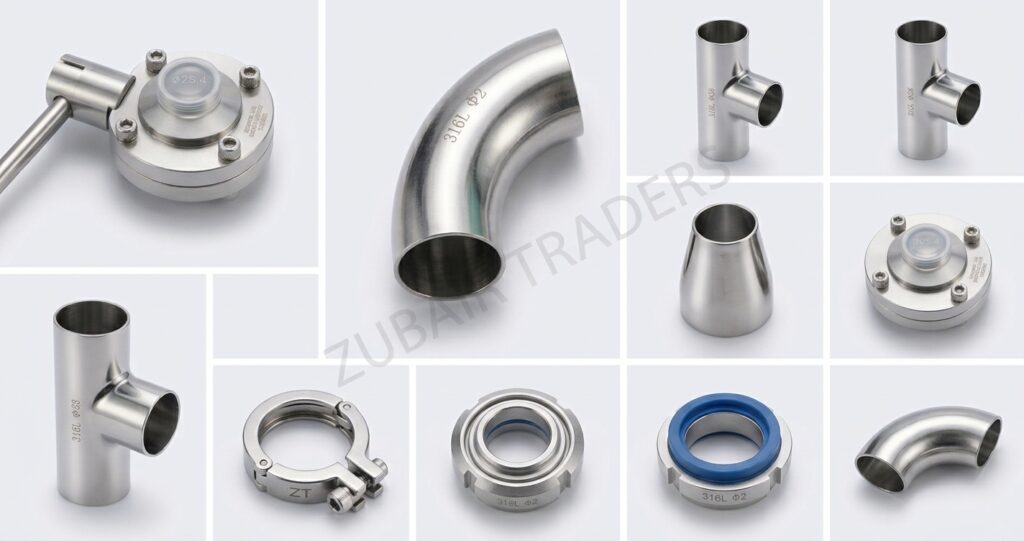
Stainless steel piping is a critical part of modern dairy and food-processing plants. Product lines carrying milk, cream, liquid food products, ingredients, water, cleaning solutions and other process fluids require materials that can withstand continuous operation while maintaining corrosion resistance, mechanical integrity and a cleanable internal surface.
For these applications, SS304L and SS316L stainless steel are among the most widely specified austenitic stainless-steel grades. Their combination of corrosion resistance, weldability, mechanical performance and fabrication characteristics makes them suitable for a wide range of food and dairy processing systems.
Zubair Traders provides a range of stainless-steel products designed for food and dairy processing applications, including SS pipes, unions, clamps, elbows, tees, crosses and butterfly valves. The principal sizes offered are 25 mm, 38 mm and 51 mm, providing practical options for process lines, transfer systems and equipment connections.
Why Stainless Steel Is Used in Dairy and Food Processing
Food-processing piping operates in demanding conditions. A piping system may be exposed to moisture, organic acids, salts, cleaning chemicals, elevated temperatures and repeated cleaning cycles. The material therefore needs to maintain its surface condition and structural integrity over extended service.
Stainless steel provides several important engineering advantages.
Corrosion Resistance
The chromium content of austenitic stainless steel allows the formation of a passive chromium-oxide layer on the surface. This passive layer provides resistance against many forms of atmospheric and process-related corrosion.
SS304L is widely used where general corrosion resistance is sufficient. SS316L contains molybdenum, which provides improved resistance to localized corrosion, particularly in environments involving chlorides and other aggressive contaminants.
The correct material should therefore be selected according to the process fluid, temperature, chloride concentration, cleaning chemicals and operating conditions.
Weldability
The low-carbon grades 304L and 316L are particularly useful for fabricated piping systems. Their reduced carbon content helps minimize the risk of chromium-carbide precipitation during welding, making them well suited to welded assemblies when appropriate welding procedures are followed.
For food-processing piping, welding quality is important not only for mechanical integrity but also for maintaining the required internal surface condition.
Cleanable Internal Surfaces
The internal surface of process piping directly interacts with the product or process fluid. Surface roughness, weld quality, joints and geometric transitions can therefore influence cleaning performance.
Properly manufactured stainless-steel tubing and fittings can provide smooth internal surfaces that support effective cleaning and reduce areas where product residues can accumulate.
ASTM A270/A270M specifically covers stainless-steel tubing intended for dairy and food-industry applications and includes requirements related to manufacturing, testing and surface finishes.
SS304L vs SS316L: Which Stainless Steel Is Better?
Both grades belong to the austenitic stainless-steel family, but their alloy compositions provide different levels of corrosion resistance.
| Property | SS304L | SS316L |
|---|---|---|
| Chromium | Approximately 18% | Approximately 16–18% |
| Nickel | Approximately 8–12% | Approximately 10–14% |
| Molybdenum | Normally not added | Approximately 2–3% |
| Carbon | Low | Low |
| Corrosion resistance | Very good | Higher, particularly against chlorides |
| Weldability | Excellent | Excellent |
| Typical application | General food and dairy processing | More demanding/corrosive processing environments |
SS304L is an economical and highly versatile choice for many food-processing installations. It is commonly used for process piping, fittings, tanks, equipment frames and fluid-transfer systems where the operating environment does not require the additional corrosion resistance of molybdenum-bearing stainless steel.
SS316L is selected when the process environment is more corrosive. Its molybdenum content provides enhanced resistance to pitting and crevice corrosion in chloride-containing environments.
The decision between SS304L and SS316L should not simply be based on the statement that one grade is “better.” Material selection should consider the complete service environment.
SS 304/316L Steel Pipes
Stainless-steel pipes form the main distribution network of a processing plant. They transport liquids between storage tanks, processing equipment, pumps, heat exchangers, filling systems and other process units.
For dairy and food applications, pipe selection involves more than nominal diameter. Important considerations include:
- Stainless-steel grade
- Outside diameter
- Wall thickness
- Manufacturing method
- Internal and external surface finish
- Dimensional tolerances
- Welding quality
- Pressure and temperature requirements
- Process-fluid compatibility
- Cleaning requirements
Zubair Traders offers stainless-steel pipes in 25 mm, 38 mm and 51 mm sizes, providing practical dimensions for a range of food and dairy processing lines.
For projects requiring a specific engineering specification, the pipe should be ordered against the applicable material and dimensional standard rather than relying solely on the commercial designation “food-grade stainless steel.”
ASTM A270/A270M is particularly relevant where tubing is specified for dairy and food-industry service. The standard covers seamless, welded and heavily cold-worked welded austenitic and ferritic/austenitic stainless-steel tubing and includes requirements for surface finish and testing.
Where pressure-service piping is required, other specifications such as ASTM A312/A312M may be applicable depending on the engineering design and procurement specification.
304/316L Unions
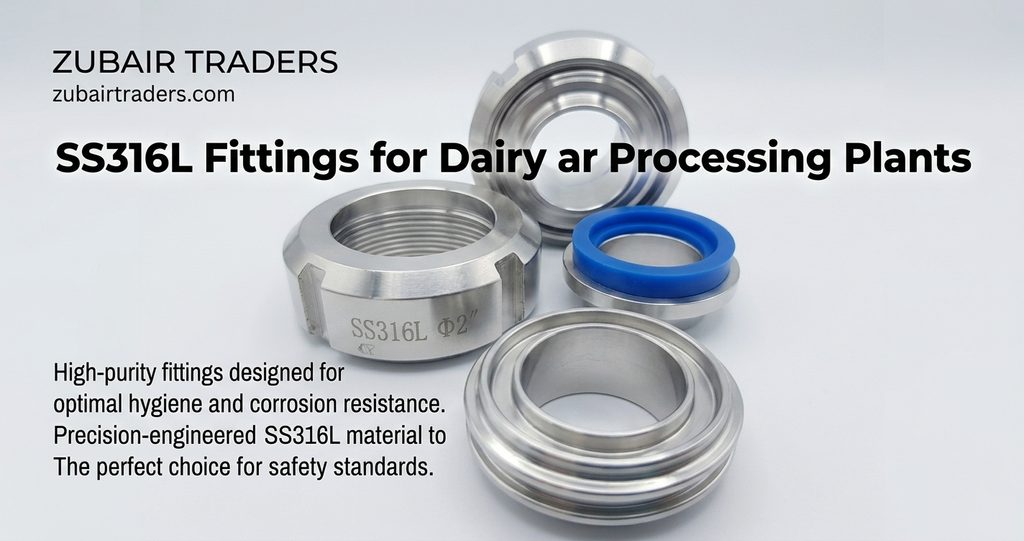
A union provides a detachable mechanical connection between sections of piping or between piping and equipment.
In a processing plant, detachable connections can be important where equipment needs to be removed, inspected, maintained or replaced.
Stainless-steel unions are particularly useful around:
- Pumps
- Processing equipment
- Tank connections
- Valve assemblies
- Branch lines
- Equipment skids
- Pipe sections requiring periodic maintenance
The connection geometry, sealing arrangement, material compatibility and dimensional accuracy are important considerations.
For food and dairy processing, the union should be manufactured from a suitable stainless-steel grade and designed so that the connection does not introduce unnecessary internal restrictions or difficult-to-clean areas.
304/316L Clamps
Stainless-steel clamps provide a practical method of connecting removable piping components.
A clamp connection can simplify assembly and disassembly compared with a permanently welded connection. This can be useful around equipment that requires regular maintenance or configuration changes.
Typical applications include connections between:
- Pipes and fittings
- Pipes and valves
- Processing equipment
- Tank outlets
- Pump assemblies
- Removable pipe sections
For a reliable installation, the clamp, ferrule, gasket and mating components must be dimensionally compatible.
The stainless-steel grade of the clamp should also be considered alongside the grade of the piping system. Using corrosion-resistant components throughout the process connection helps maintain consistency across the installation.
Zubair Traders supplies stainless-steel clamps for the 25 mm, 38 mm and 51 mm product range.
304/316L Elbows
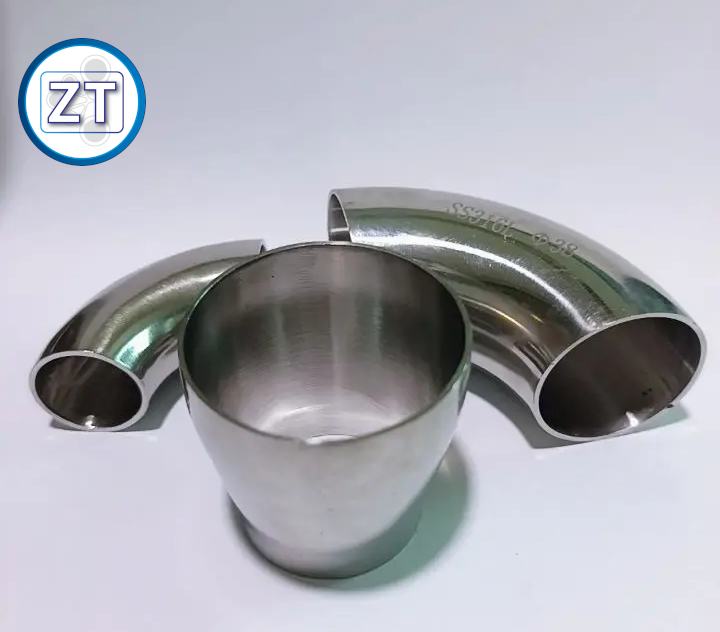
Elbows are used to change the direction of a process pipeline.
Common configurations include 45-degree and 90-degree elbows, depending on the piping layout and process requirements.
In food and dairy plants, elbow geometry matters because excessive turbulence, abrupt transitions and unsuitable internal profiles can affect flow characteristics and cleaning performance.
A properly selected elbow should provide:
- Correct dimensional compatibility
- Appropriate material grade
- Smooth internal geometry
- Adequate mechanical strength
- Compatibility with the associated pipe and connection system
Stainless-steel elbows in SS304L and SS316L can be selected according to the process environment and project specification.
For fabricated wrought fittings, ASTM A403/A403M — Standard Specification for Wrought Austenitic Stainless Steel Piping Fittings is an important reference where the applicable procurement specification calls for it.

304/316L Tees
A stainless-steel tee allows a process line to divide into a branch connection or combine flow from another line.
Tees are commonly used in processing systems for:
- Product distribution
- Tank connections
- Branch process lines
- Water and utility connections
- Equipment connections
- CIP-related piping arrangements where specified
The three connections must maintain dimensional compatibility with the associated piping system.
For food-processing applications, particular attention should be given to the internal transition between the run and branch. Smooth geometry helps support effective fluid movement and cleaning.
Zubair Traders offers stainless-steel tees in the principal 25 mm, 38 mm and 51 mm sizes.
304/316L Cross Fittings
A stainless-steel cross provides four connection points and can be used where a process piping arrangement requires multiple branches from a common intersection.
Cross fittings may be used in specialized distribution arrangements, equipment connections and process manifolds.
As with tees and elbows, the fitting material should be compatible with the connected piping. SS304L is suitable for many general processing environments, while SS316L can be specified where greater resistance to chloride-containing or otherwise aggressive environments is required.
Dimensional accuracy is particularly important for multi-connection fittings because four connected lines must align correctly with the piping system.
304/316L Butterfly Valves
Butterfly valves are widely used for controlling or isolating fluid flow in process piping.
A typical stainless-steel butterfly valve consists of a circular disc mounted on a stem. Rotating the stem changes the position of the disc and controls the flow through the pipeline.
They offer several practical advantages:
- Compact construction
- Low weight compared with many alternative valve designs
- Rapid operation
- Low space requirement
- Suitable for isolation and flow-control duties when correctly specified
- Compatibility with stainless-steel piping systems
In dairy and food processing, valve selection should consider the process medium, operating temperature, pressure, cleaning regime, seal material and stainless-steel grade.
SS304L and SS316L valve bodies can be selected according to the corrosion environment and process requirements.
Zubair Traders supplies stainless-steel butterfly valves for the 25 mm, 38 mm and 51 mm size range.
25 mm, 38 mm and 51 mm Stainless Steel Piping Components
Pipe diameter has a direct influence on flow velocity, pressure loss and overall system capacity.
Zubair Traders focuses on three principal sizes:
25 mm
Suitable for smaller process lines, equipment connections, branch lines and lower-flow applications.
38 mm
A useful intermediate size for process transfer and distribution systems where greater flow capacity is required than a 25 mm line.
51 mm
Suitable for higher-flow process lines and larger equipment connections within the applicable plant design.
The actual flow capacity of a pipe cannot be determined from diameter alone. Engineers should also consider pipe internal diameter, wall thickness, fluid viscosity, density, operating temperature, flow rate, pressure drop and system configuration.
Material Selection, Surface Finish and Fabrication
The performance of stainless-steel piping depends on more than the grade stamped on the product.
Three areas deserve particular attention: material chemistry, fabrication quality and surface condition.
Material Chemistry
SS304L and SS316L should be supplied against a defined material specification where project documentation requires traceability.
For SS316L, molybdenum content is particularly important because it differentiates the alloy from SS304L and contributes to improved resistance to localized corrosion.
Welding
Welded stainless-steel piping requires appropriate welding procedures, control of heat input and proper post-weld treatment where required by the specification.
Poorly executed welds can create discoloration, surface irregularities and corrosion-sensitive areas. For critical process lines, welding inspection and documentation may form part of the project quality requirements.
Surface Finish
Surface finish is an important engineering characteristic for food-processing tubing.
ASTM A270/A270M includes specific provisions for surface finishes, including mechanically polished and electropolished options as well as specified maximum roughness values.
The required finish should therefore be stated in the purchase specification rather than assumed from the stainless-steel grade alone.
Applicable Standards for Stainless Steel in Food Processing
International standards provide a technical framework for specifying material, dimensions, fabrication, testing and inspection.
ASTM Standards
ASTM A270/A270M
Standard Specification for Seamless and Welded Austenitic and Ferritic/Austenitic Stainless Steel Tubing
ASTM A270/A270M is particularly relevant to dairy and food-industry tubing. It addresses seamless, welded and heavily cold-worked welded tubing and includes requirements concerning heat treatment, chemical analysis, mechanical testing and surface finish. The current ASTM listing identifies A270/A270M-24 as the active edition.
ASTM A312/A312M
Standard Specification for Seamless, Welded, and Heavily Cold Worked Austenitic Stainless Steel Pipes
This specification is commonly referenced for austenitic stainless-steel pipe intended for high-temperature and general corrosive service where pressure-service requirements apply.
ASTM A403/A403M
Standard Specification for Wrought Austenitic Stainless Steel Piping Fittings
This specification is relevant to wrought stainless-steel fittings such as elbows, tees and other piping components when the applicable procurement specification requires ASTM A403/A403M.
ASTM A967/A967M
Standard Specification for Chemical Passivation Treatments for Stainless Steel Parts
ASTM A967/A967M provides requirements for chemical passivation treatments applied to stainless-steel parts. Passivation can be an important post-fabrication treatment where specified by the application or project documentation.
ASME Standards
ASME B31.3 — Process Piping
ASME B31.3, Process Piping is one of the major engineering codes used for process piping systems.
It addresses areas including:
- Design
- Materials
- Fabrication
- Assembly
- Examination
- Inspection
- Testing
ASME describes B31.3 as applying to process piping and related processing plants and terminals.
Importantly, B31.3 is a piping-system code, not simply a material specification for an individual pipe or fitting. A project claiming B31.3 compliance therefore requires the piping system to be engineered, fabricated, examined and tested in accordance with the applicable code requirements.
ASME BPE — Bioprocessing Equipment
ASME BPE, Bioprocessing Equipment covers materials, design, fabrication, inspection, testing and certification for equipment used in bioprocessing and other applications with high levels of controlled hygienic requirements.
Although BPE is principally associated with bioprocessing and pharmaceutical applications, its engineering principles can be relevant to other high-purity fluid-processing systems where the project specification requires them.
ASME also provides a BPE certification program under which certified manufacturers can apply the appropriate BPE certification marking to qualifying components.
EN Standards
EN 10357:2022
Austenitic, austenitic-ferritic and ferritic longitudinally welded stainless steel tubes for the food and chemical industry
EN 10357:2022 is directly relevant to stainless-steel tubes used in food and chemical processing. It specifies dimensions, tolerances, materials, internal and external surface characteristics and marking for longitudinally fusion-welded stainless-steel tubes.
This makes EN 10357 particularly useful when specifying welded stainless-steel tubing for European-style food and beverage processing installations.
EN 10088-1
Stainless steels — Part 1: List of stainless steels
EN 10088-1 provides a standardized system for identifying stainless-steel grades and chemical compositions. It is useful when specifying the precise stainless-steel material rather than relying only on commercial grade names.
ISO Standards and Technical References
ISO standards can also form part of an international procurement specification for stainless-steel materials and processing equipment.
One important consideration is that ISO standards must be checked for current status and exact scope before being specified on a purchase order. Some older food-industry stainless-steel standards have been withdrawn or superseded.
For example, historical ISO references include specifications for stainless-steel tubes, bends, tees and clamp couplings used in food-industry applications. These should not automatically be represented as current requirements without confirming the applicable edition and status.
For an international project, the correct approach is to specify the current edition of the applicable standard, together with material grade, dimensions, surface finish, testing requirements and documentation.
Pakistan Standards and PSQCA Requirements
In Pakistan, product and material requirements may also be governed by Pakistan Standards and Quality Control Authority (PSQCA) standards and applicable regulations.
PSQCA operates technical committees covering areas including Milk & Dairy, Meat/Poultry/Fish & Their Products, Food Hygiene and the Code of Hygienic and Sanitary Conditions in Manufacturing Food Items.
PSQCA also publishes Pakistan Standards adopting international specifications. For stainless steel, one example is PS-ISO 16143-1:2015, Stainless steel for general purpose — Part 1: Corrosion-resistant flat products.
The applicable Pakistani standard depends on the exact product and application. Therefore, a food-processing project should identify the relevant PSQCA standard or adopted international standard in its technical procurement specification rather than applying one standard universally to every pipe, fitting or valve.
Why Choose Zubair Traders for SS304L & SS316L Products?
For dairy and food-processing plants, selecting the right stainless-steel components is an important part of maintaining reliable process infrastructure.
Zubair Traders provides high-quality SS304L and SS316L stainless-steel products specifically for dairy and food-processing applications, including:
- SS Stainless Steel Pipes
- SS Unions
- SS Clamps
- SS Elbows
- SS Tees
- SS Crosses
- SS Butterfly Valves
Our principal product sizes are 25 mm, 38 mm and 51 mm, making our range suitable for a variety of process piping and equipment connection requirements.
Quality is a central part of our product offering. Zubair Traders supplies products that are tested for quality and backs its products with a money-back guarantee, giving customers additional confidence when sourcing stainless-steel components for their processing plants.
Whether you are installing a new dairy processing line, upgrading an existing food-processing plant, replacing piping components or sourcing stainless-steel fittings and valves for equipment connections, Zubair Traders provides SS304L and SS316L solutions focused on material quality, dimensional consistency and dependable industrial performance.